
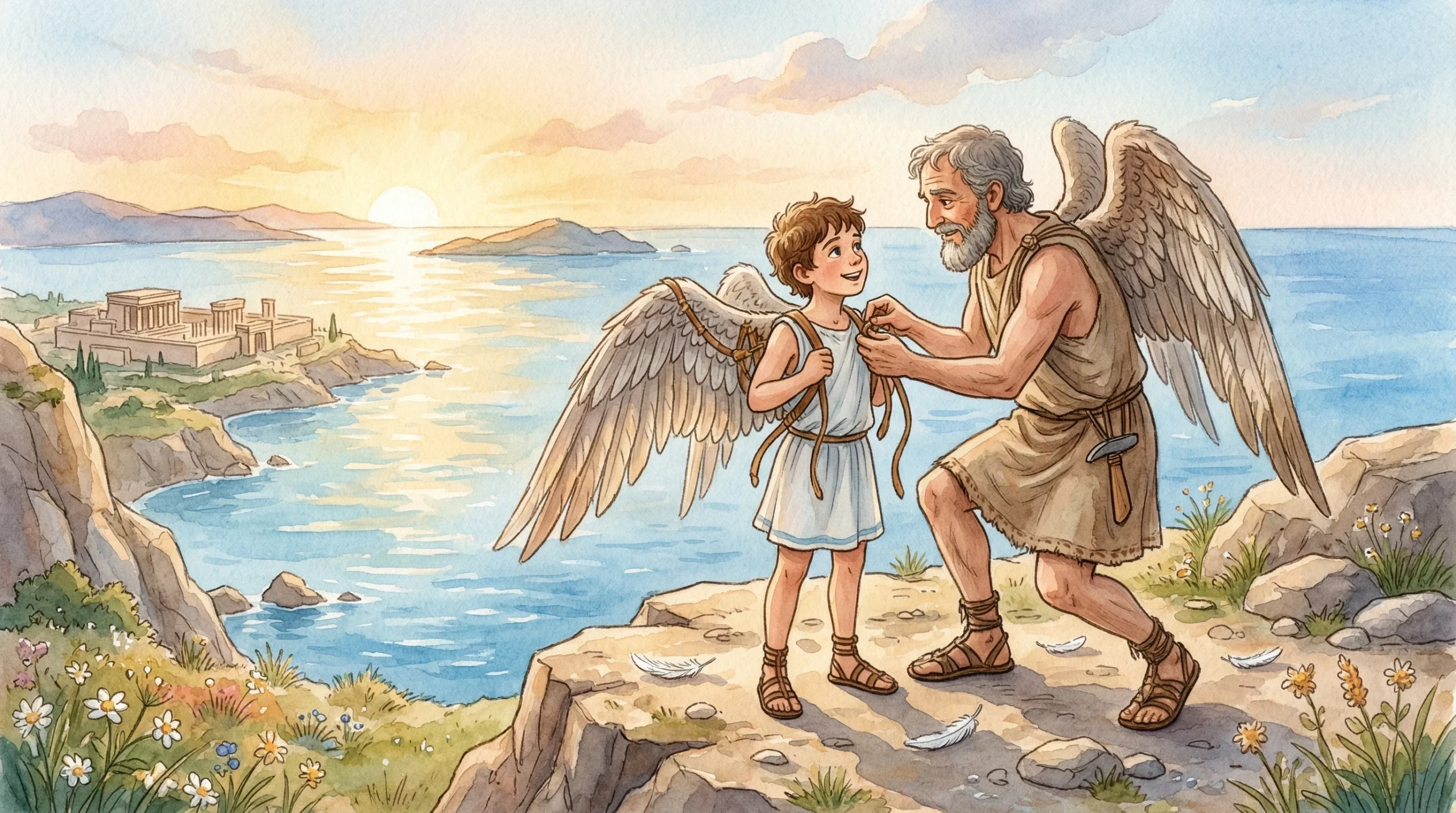
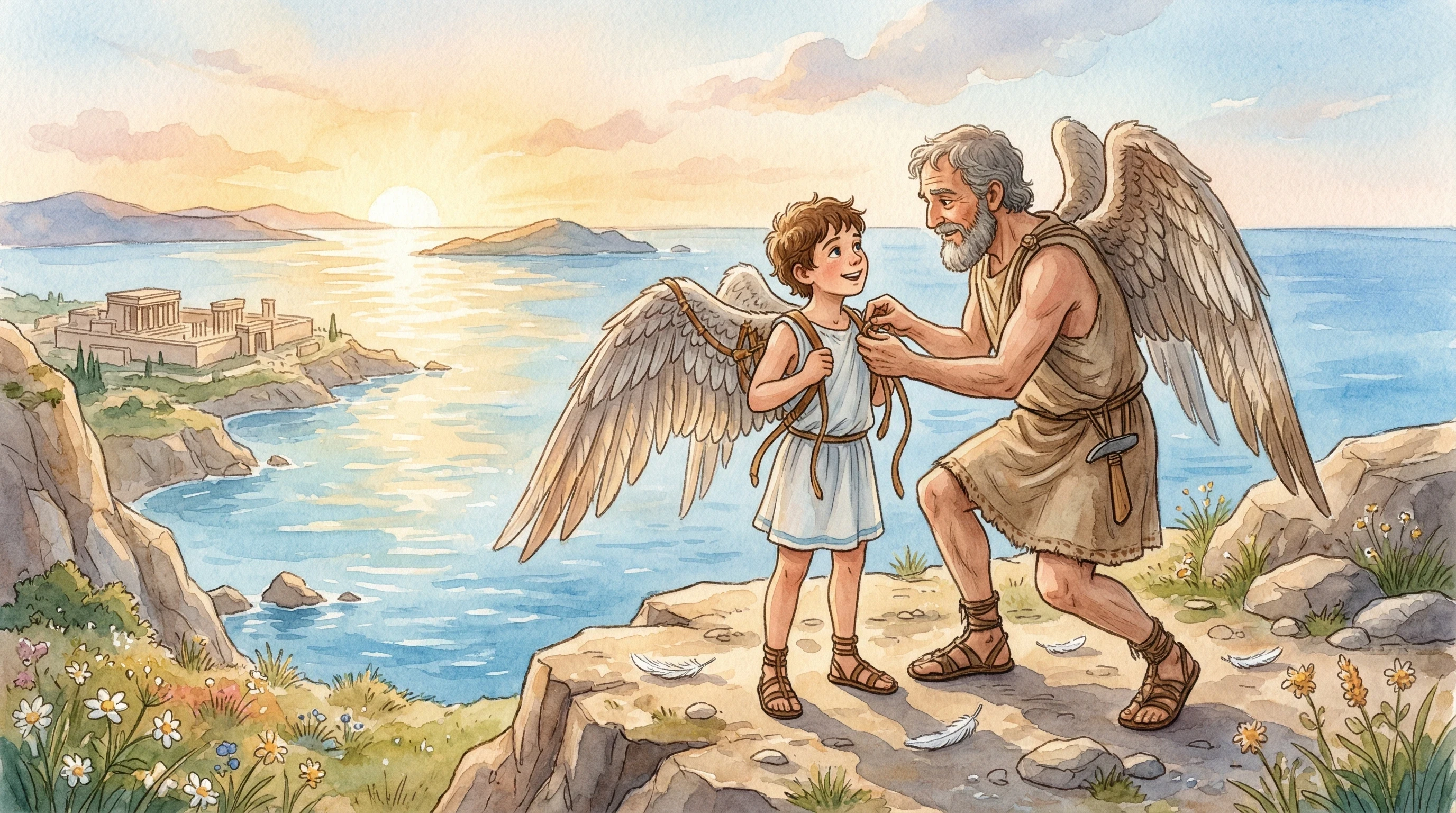
Long ago, there lived a great inventor named Daedalus and his young son, Icarus.
Daedalus was known for his extraordinary skill. He was a sculptor whose hands could shape figures so lifelike they seemed almost ready to breathe. But he was more than a sculptor — he was an inventor, too. His mind saw possibilities where others saw only stone and wood.
When King Minos of Crete heard of his talent, he invited Daedalus to his island to create marvellous things for his palace. Among these was a great and winding maze — the Labyrinth — built to hold a mysterious creature called the Minotaur, which the king wished to keep hidden from the world.
King Minos rewarded Daedalus generously, and while the work continued, Daedalus and Icarus lived comfortably within the palace walls. But when the Labyrinth was complete and Daedalus learned what it would be used for, his heart grew uneasy. He longed to leave Crete at once.
Yet when he asked to depart, King Minos refused. He feared that Daedalus might reveal the secrets of the Labyrinth, and so he would not allow him to leave the island.
And so, though they longed for freedom, Daedalus and Icarus were kept in Crete. High walls and watchful guards surrounded them, the sea stretched endlessly in every direction, and no boat was permitted to carry them away.
Often, Icarus would stand at the edge of the cliffs, gazing out across the shining water.
“Father,” he would ask, “will we ever be able to get away?”
Daedalus would look up at the birds gliding through the sky, their wings bright against the sun — and slowly, quietly, an idea began to take shape.
“Yes,” he said at last, a spark of hope kindling in his mind. “We will find a way.”
From that day on, Daedalus walked along the cliffs each morning, scattering crumbs for the birds. He watched them swoop and soar, their wings catching the sunlight as they rose effortlessly into the sky.
And as he watched, he began to gather feathers — small ones, large ones, soft ones carried on the wind. He collected them quietly, one by one, tucking them away where no one would think to look. From his blankets, he drew strands of wool, and from the candles, he saved softened wax.
Carefully — oh, so carefully — he bound the feathers together, shaping them with wool and warm beeswax into great wings.
At last, the wings were ready.
Daedalus fastened a pair to his own shoulders, and another to Icarus. The feathers shimmered pale gold and white in the sunlight.
“Listen carefully,” Daedalus said, his voice steady but serious. “We must fly a middle path. If you fly too low, the sea will dampen your wings and make them heavy. If you fly too high, the sun will soften the wax that holds them together, and the feathers will fall away.”
Icarus nodded, his eyes shining with excitement.
“Yes, Father.”
And with that, they leapt.
For a moment, there was only the rush of air — and then, wonder, as the wings lifted them.
They were flying.
The island fell away beneath them. The sea stretched wide and sparkling, and the wind carried them onward. Icarus laughed with delight, rising and dipping like the birds he had so often watched.
“Father, look!” he called. “I can fly!”
Daedalus smiled, though his eyes remained watchful.
“Stay close,” he reminded him gently.
But the sky was vast, and the joy of flight was like nothing Icarus had ever known. Little by little, he forgot his father’s warning. He soared higher and higher, drawn toward the warmth and brilliance of the sun.
The air grew warmer. The wax began to soften.
One by one, the feathers came loose.
“Icarus!” Daedalus called, his voice filled with sudden fear. “Come back!”
But it was too late.
The wings gave way, and Icarus fell, down and down toward the shimmering sea below.
Daedalus circled helplessly above, his heart filled with sorrow.
At last, he flew on alone, carrying both his grief and his love with him.
And though the story is a sad one, it has been told for generations as a gentle reminder:
to be brave and curious,
to listen to those who guide us,
and to remember that the middle path is often the wisest way.