
After the strange and sorrowful events of the golden touch, King Midas was no longer quite the same.
He no longer filled his halls with glittering treasures, nor did he sit counting coins late into the night. The gold still shone in his palace, but it no longer held his heart.
Instead, Midas found himself drawn to quieter places.
He would wander beyond the palace walls, into soft green hills and shaded woods, where the air was cool and the world felt simple again. There he would sit beside murmuring streams or rest beneath whispering trees, listening to the rustle of leaves and the distant song of birds.
Sometimes, his daughter walked with him, gathering flowers as she always had. And Midas — wiser now — would truly look at them: their colours, their softness, their fleeting beauty.
In time, he made a friend.
It was Pan, the merry god of the wild woods, who played his pipes among the trees. Pan’s music was simple and bright, skipping through the air like sunlight on water, and Midas grew to love it dearly. Sitting beside him on a fallen log, listening contentedly, the king discovered a kind of peace he had never known within his golden halls.
And yet… although Midas had learned much, he had not learned everything.
For while he no longer longed for riches, he still believed — just a little too confidently — that he knew best.
One bright morning, word spread across the land of a most unusual contest.
Apollo himself had come down to earth. And because Pan had been boasting (just a little), Apollo had challenged him to a contest of music.
Apollo stood tall and radiant, his golden lyre gleaming in his hands. Pan, cheerful and untamed, lifted his pipes of reeds with a grin.
King Midas, curious, went to watch.
He stood among the listeners as the music filled the air — first one melody rich and golden as sunlight, then the other light and wild and free, dancing like the wind through the trees.
When at last the music ended, a hush fell.
The crowd murmured, then agreed: Apollo was the winner.
But King Midas stepped forward.
“I think Pan should win,” he said firmly. “His music is honest and joyful. It sounds like the world I love.”
Apollo’s bright eyes narrowed — just a little.
“Well, King Midas,” he said slowly, “it seems your ears are not quite large enough to hear truly excellent music. But we can easily put that right.”
Before Midas could ask what he meant, he felt a tiny tickle behind his ears.
Just an itch.
He reached up to scratch… and paused.
His fingers touched something soft.
Soft… and furry.
The itch grew stronger. The softness grew larger.
“Oh dear,” Midas murmured, patting the side of his head. “That feels… unusual…”
Pan’s eyes widened. Apollo folded his arms.
Very carefully, Midas gave the strange new shape a gentle tug.
It flopped.
It twitched.
It was unmistakably an ear — a long, furry, floppy donkey’s ear.
“Oh!” cried Midas.
And then — oh no — the other side began to itch as well.
Moments later, there were two.
Two long, furry, floppy donkey’s ears — on a king!
Midas tugged them this way and that, hoping they might come off or shrink back to normal. But they only wobbled most unhelpfully and stayed exactly where they were.
“Oh dear,” he muttered. “What am I to do now?”
At last, he had an idea.
He wrapped a long purple scarf around his head, twisting and folding it into a grand and rather magnificent turban. It covered his ears perfectly — and, to his surprise, looked quite splendid.
When he returned to the palace, everyone gasped.
Not because they suspected anything…
…but because they thought the king had invented a wonderful new fashion.
Before long, half the court was wearing purple turbans.
And soon — very soon everyone was.
Midas sighed.
If only they knew…
Of course, there was one small problem.
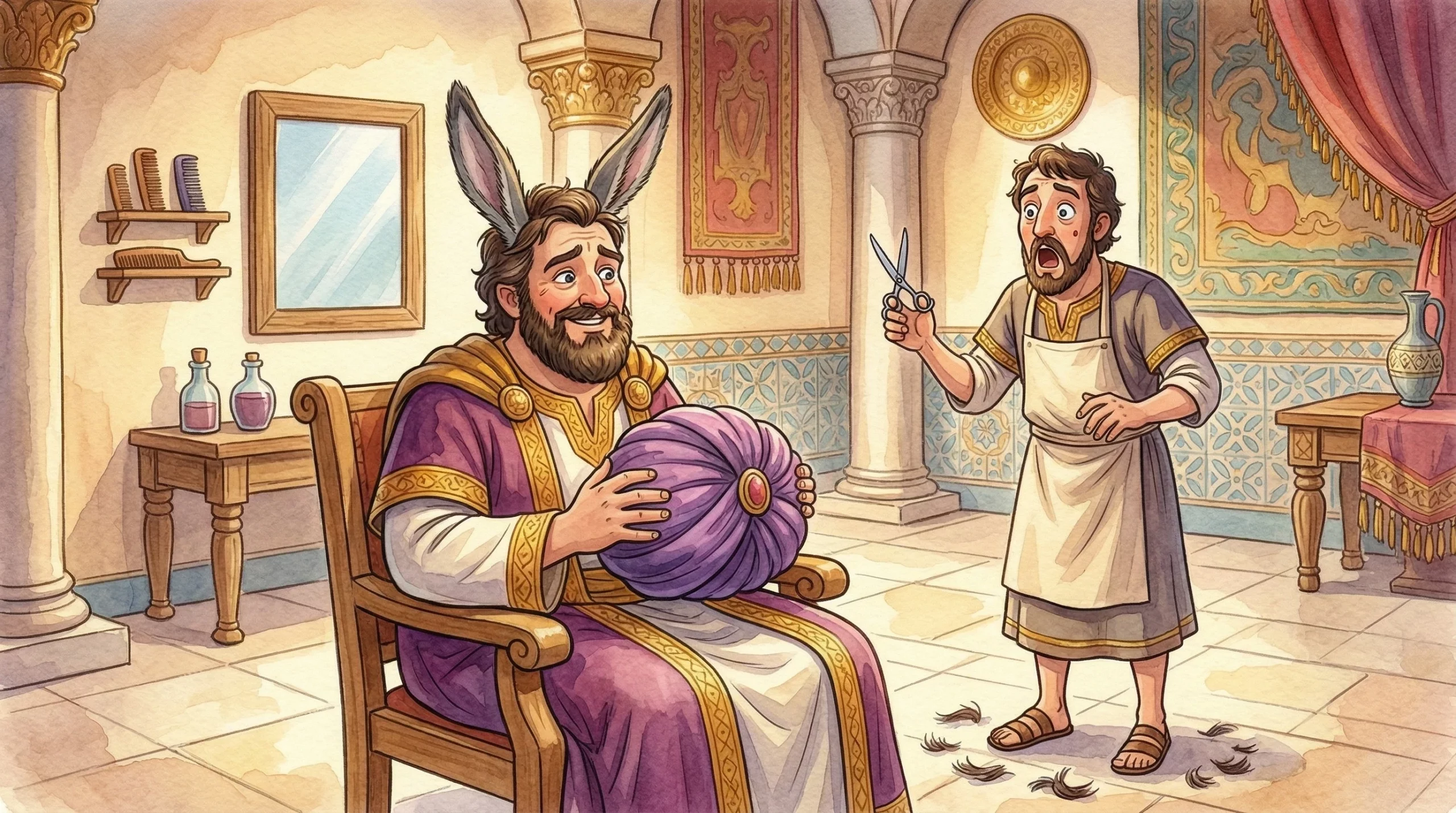
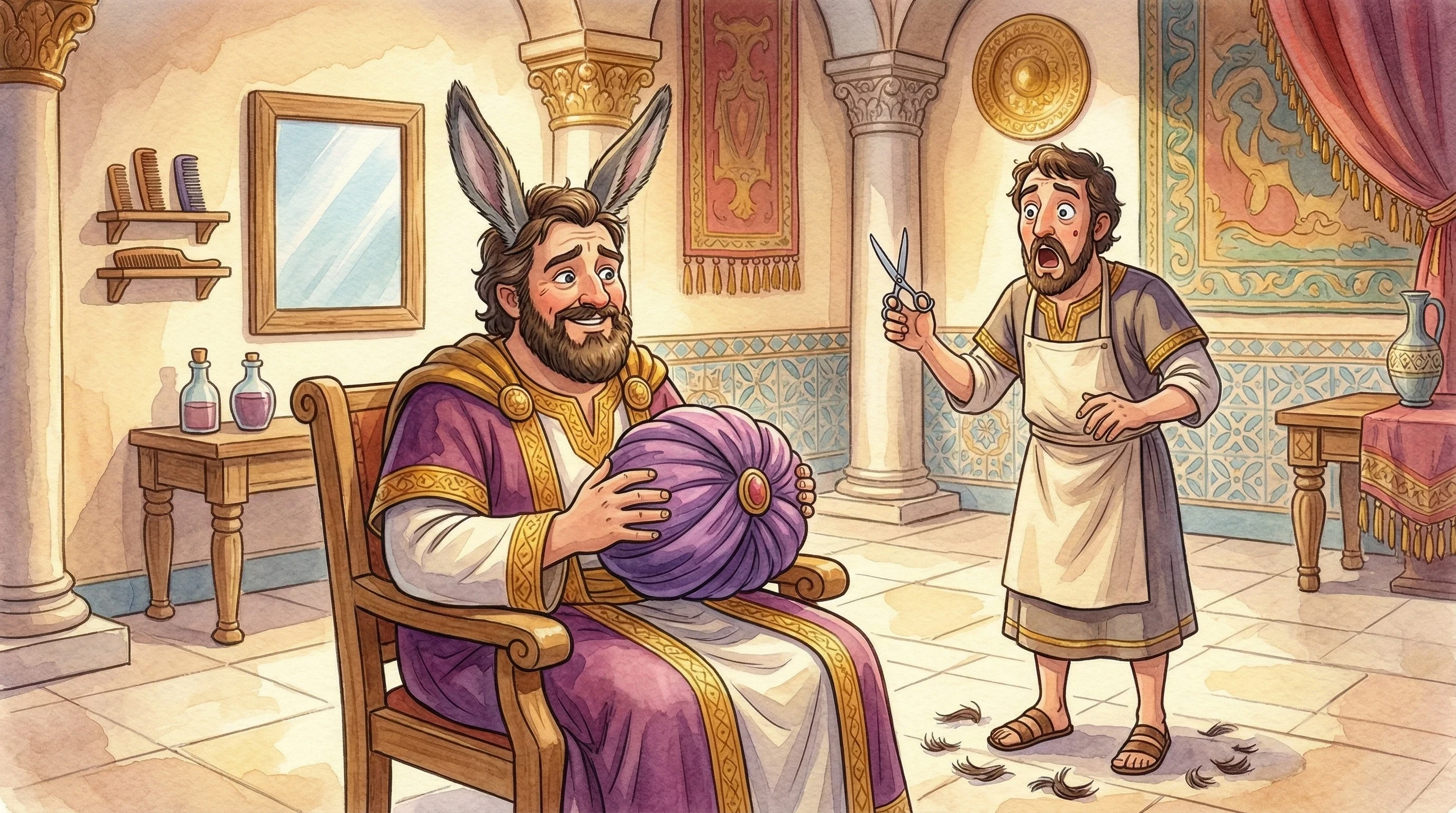
Sooner or later, someone would have to cut the king’s hair.
And that someone was the royal barber.
When Midas removed his turban, the barber’s eyes grew as wide as saucers.
The king quickly raised a hand.
“Please,” he whispered, “you must tell no one. Not a soul.”
The barber nodded. He meant to keep the secret — he truly did.
But it was such a large secret.
It sat inside him and wriggled.
It pressed and pushed.
It made him feel as though he might burst!
At last, he could bear it no longer.
At dawn, he crept quietly from the palace and hurried to a lonely spot by the riverbank. There, he dug a small hole in the soft earth.
He looked left.
He looked right.
No one.
He bent down, placed his mouth close to the hole, and whispered:
“King Midas has donkey’s ears!”
Then he quickly covered the hole, patted the earth flat, and hurried away — feeling wonderfully relieved.
But secrets, you see, have a way of escaping…
especially when they are planted in the ground.
From that very spot, a cluster of tall reeds began to grow.
They stretched up toward the sky, drinking in the river water and the golden sunlight. And when the wind whispered through them, they whispered back:
“King Midas has donkey’s ears…
King Midas has donkey’s ears…”
At first, only the birds heard.
Then the shepherds.
Then the whole countryside.
And that — dear listener — is how the secret spread.
And how, at last, it came to be told to you.