
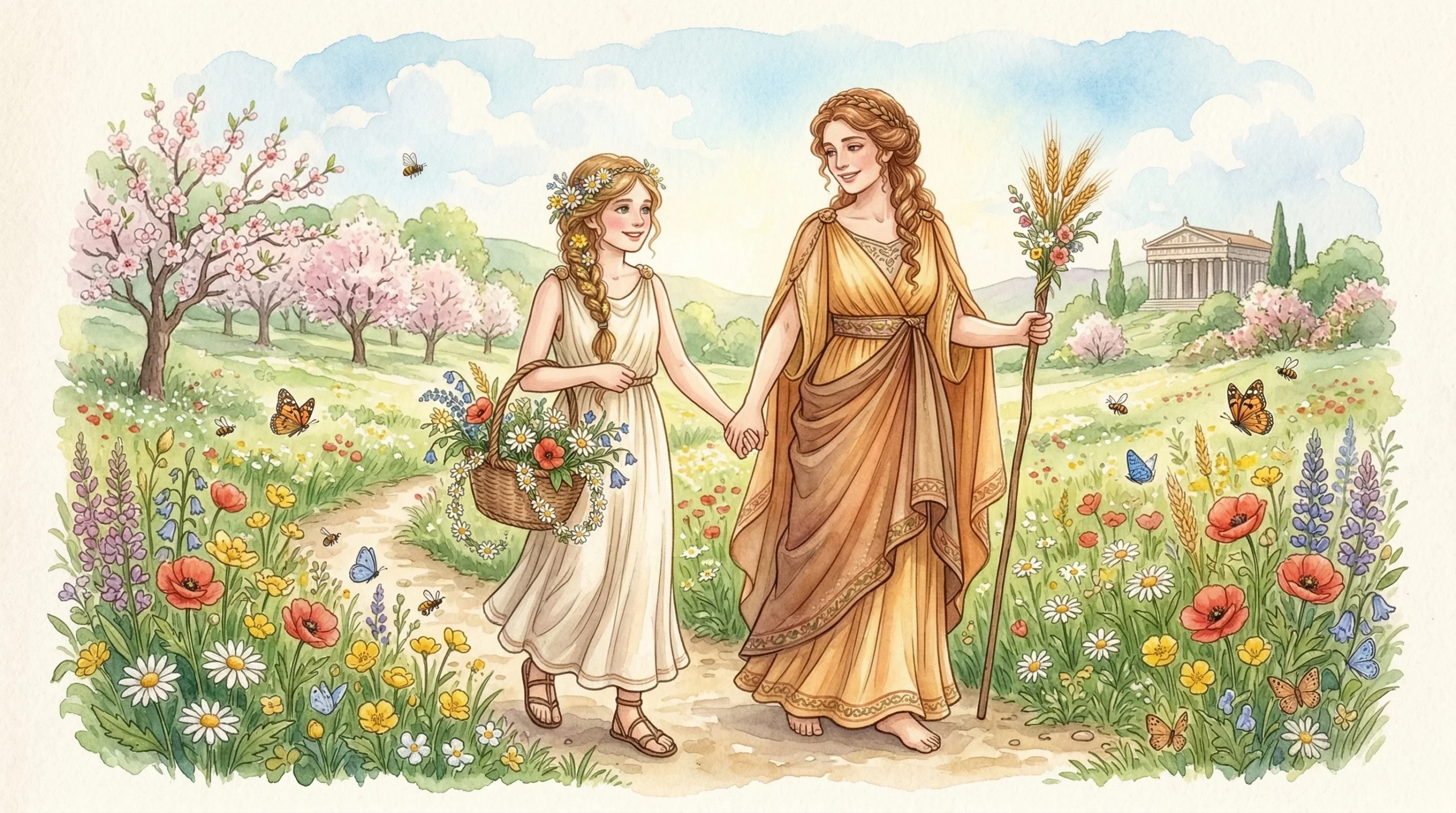
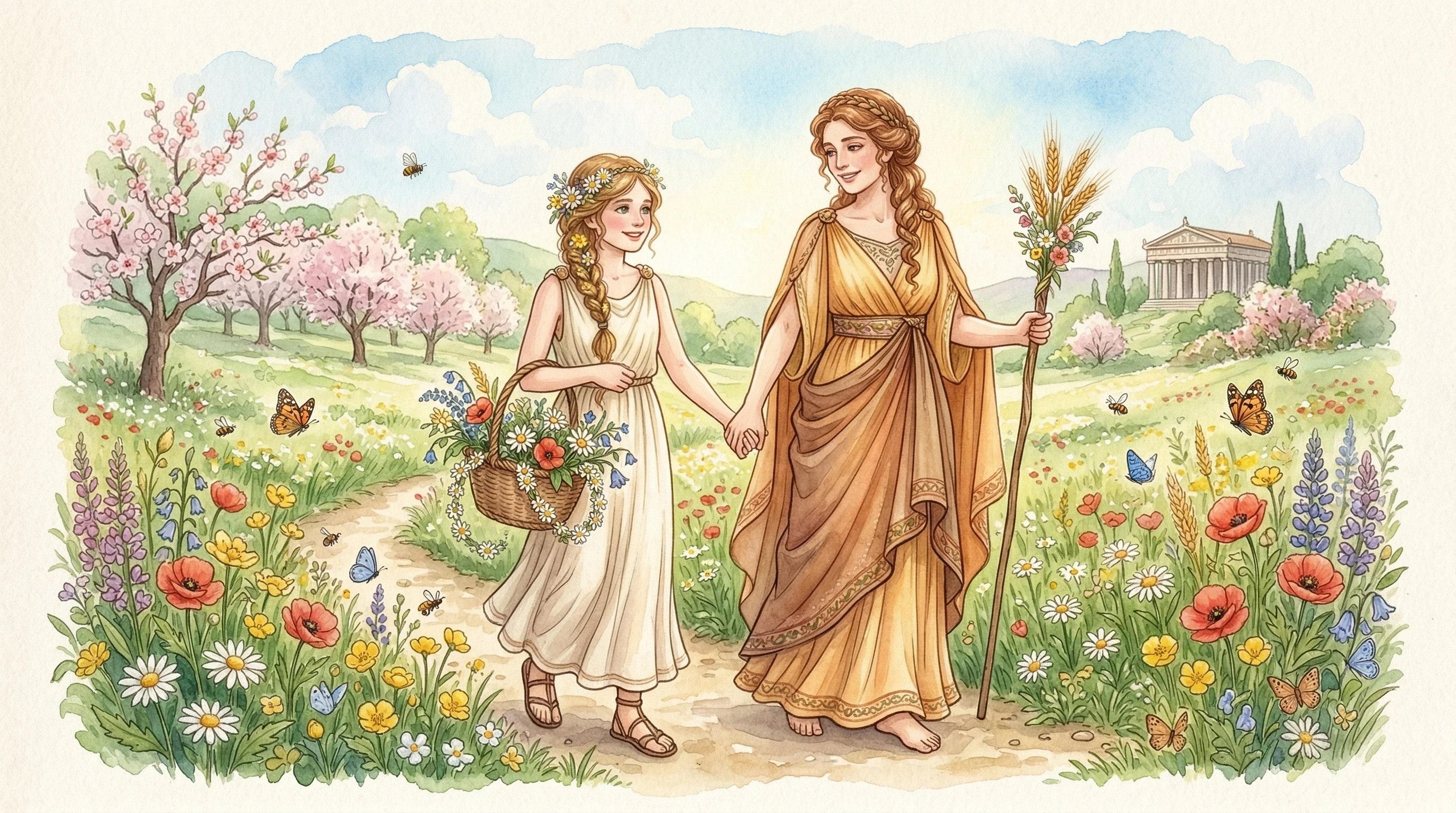
This is a gentle retelling of an ancient Greek myth. Like many old stories, there are different versions, and this one has been adapted for younger readers to focus on the changing seasons and the love between Demeter and Persephone.
Long ago, when the world was young and every flower held a little magic, there lived a mother and daughter who cared for the earth. Their names were Demeter and Persephone.
Demeter guided the growing of every seed, and Persephone, bright and curious, loved the world just as dearly. She wandered through meadows at her mother’s side, breathing in the sweet scent of blossoms. She gathered daisies to weave into chains and laughed as butterflies danced around her.
One spring morning, Persephone came upon a meadow so full of flowers it seemed to sing with colour. Delighted, she knelt to pick a handful of her favourites—and in that quiet moment, the earth shivered beneath her.
Before she could call out, the ground opened, and Hades, the solemn king of the underworld, swept her away. He had watched Persephone from afar and desired her as his queen in his dark and distant realm. Knowing Demeter would never agree, he took her without warning, forgetting the sorrow such an act would bring.
The underworld was dim and still. Its gardens were pale and silent, and Persephone longed for the warmth and light of the world above. She refused all food, hoping—knowing—that her mother would come for her.
Above ground, Demeter searched ceaselessly. She no longer tended the fields or flowers; she forgot everything except the search for her daughter. The earth began to reflect her sorrow—flowers wilted, crops failed, and as Demeter wept, the trees let fall their leaves.
She asked the rivers, the winds, and every creature of field and forest. At last, weary and heartsick, she sank down beside a river. There, the gentle reed nymphs whispered the truth:
“Your daughter has been taken below.”
Grief swept over Demeter like a winter storm. She went to Zeus, ruler of the sky, and begged him to help her. Seeing the earth growing barren and silent under her sorrow, Zeus agreed that something must be done.
He sent word to the underworld that Persephone must be returned.
At that moment, Persephone’s strength had nearly faded. After so long without food, she finally—reluctantly—ate from a single pomegranate, hoping only to steady herself.
One seed… then another…
Until she had eaten six in all.
When Demeter reached her daughter, she gathered her into her arms with tears of joy. But even in that moment of reunion, an ancient law could not be undone:
Anyone who eats food from the underworld must return there for part of each year.
And so Zeus offered a compromise.
Persephone would spend six months above the earth with her mother, bringing spring and summer wherever she stepped. And for six months, she would return to the underworld. During that time, the world would grow quiet and still, waiting patiently for her return.
Every year since, when Persephone comes back, blossoms open, daffodils lift their golden faces, and the earth warms with her laughter.
And every autumn, when she goes below, the leaves fall softly, holding the promise that she will come again.
And that is why the seasons turn—
a story of love, loss, and return,
and the gentle, certain truth that after every winter… spring will always follow.