
Screen Time Series: A Parent’s Guide Part Eight
This article is part of the Screen Time Series: A Parent’s Guide, exploring how families can build healthy digital habits and balanced screen use.
Beyond screen time limits — preparing children for a digital world
Throughout this series, we’ve talked a great deal about managing screen time — setting boundaries, handling conflict, recognising warning signs, and finding balance. All of that matters. But there’s a bigger picture too. Screen time limits are only one part of preparing children for the digital world they are growing up in.
The goal was never really to raise children who use screens less. It was to raise children who use screens well — thoughtfully, safely, and with a healthy sense of their own relationship with technology. That’s what it means to be a digital citizen, and it’s one of the most important things we can help our children become. And it’s something that can be nurtured from a surprisingly young age.
What Is a Digital Citizen?
A digital citizen is someone who uses technology responsibly, thoughtfully, and ethically. That includes:
- Understanding how to stay safe online
- Treating others with respect in digital spaces
- Thinking critically about what they see, read, and share
- Understanding that their online actions have real-world consequences
- Knowing when to step away and look after their own wellbeing
These aren’t skills children develop automatically. Like reading, riding a bike, or managing money, they need to be taught — gradually, age-appropriately, and with plenty of patience.
Start with Values, Not Rules
The most resilient digital citizens aren’t those who had the strictest screen time rules growing up. They’re the ones whose families talked openly about values — kindness, honesty, respect, responsibility — and helped them see how those values apply online just as much as off.
A useful starting point is to ask your child some simple questions:
- Would you say that to someone’s face?
- How would you feel if someone posted that about you?
- Does this feel right — or does something feel a bit off?
- Who might see this, and how might they feel?
These questions don’t require a lecture. Asked naturally and without accusation, they build the habit of pausing to think before posting, sharing, or responding — a habit that will serve children well throughout their lives.
Digital Literacy — Learning to Think Critically Online
One of the most important gifts you can give a child in the digital age is the ability to think critically about what they encounter online. The internet is an extraordinary resource — and also a space full of misinformation, manipulation, and content designed to provoke rather than inform.
Children who develop digital literacy learn to ask:
- Where did this come from? Is it a reliable source, or could anyone have written it?
- Why was this made? Is someone trying to inform me, sell me something, or make me feel a certain way?
- Is this the whole story? Are there other perspectives worth considering?
- Does this seem too good — or too outrageous — to be true?
You don’t need to turn every online moment into a lesson. But when something comes up naturally — a dubious claim shared by a friend, a sensational headline, an advertisement that feels a little too targeted — it’s worth pausing together and talking it through. These small conversations, accumulated over years, build genuinely robust critical thinking.
Online Kindness and Digital Empathy
The internet can feel anonymous in ways that make it easier to say things people would never say in person. Children and teenagers are not immune to this — in fact, they’re often at the centre of it, both as those who experience unkindness online and as those who sometimes dish it out without fully understanding the impact.
Digital empathy — the ability to recognise that there is a real person with real feelings on the other side of every screen — is something worth nurturing explicitly:
- Talk about things you see online together: “How do you think that person felt when they read those comments?”
- If your child has been unkind online, treat it the same way you would unkindness in person — calmly, seriously, and with a focus on making it right
- If your child has experienced unkindness or bullying online, take it seriously. Online cruelty is not less real because it happens on a screen, and the impact on young people’s mental health can be significant
- Help children understand that screenshots last forever, and that words sent in a moment of anger or boredom can cause lasting harm
Privacy, Footprints, and Thinking Ahead
Children and teenagers often share online without fully grasping the permanence or reach of what they’re putting out into the world. Building an understanding of digital footprints — the trail of information we leave behind online — is an increasingly essential life skill.
Some conversations worth having:
- Personal information: What’s safe to share, and what isn’t? Full name, school, location, and daily routines are things to protect — even among people who seem friendly online.
- Photos and images: Once an image is shared, you lose control of it. This applies to photos of themselves, but also to photos of others — always ask before posting a picture of a friend.
- Passwords and privacy settings: Does your child know how to check who can see their posts? Do they understand why strong passwords matter?
- Future footprints: Many young people don’t yet realise that future employers, universities, and even romantic partners may one day search their name online. What kind of digital presence do they want to have?
These aren’t conversations to have once and consider done. They’re worth revisiting regularly as children get older and their online lives become more complex.
Understanding How Platforms Work
One of the most empowering things you can teach a child is that the platforms they use are not neutral spaces — they are businesses, designed to keep users engaged for as long as possible, and they use sophisticated techniques to do so.
Understanding this doesn’t mean children have to give up social media or their favourite games. But it does give them something valuable: the ability to notice when a platform is working on them, rather than for them.
Some ideas for opening up these conversations:
- Talk about algorithms: “Have you noticed that once you watch one video, it keeps suggesting more? Why do you think that is?”
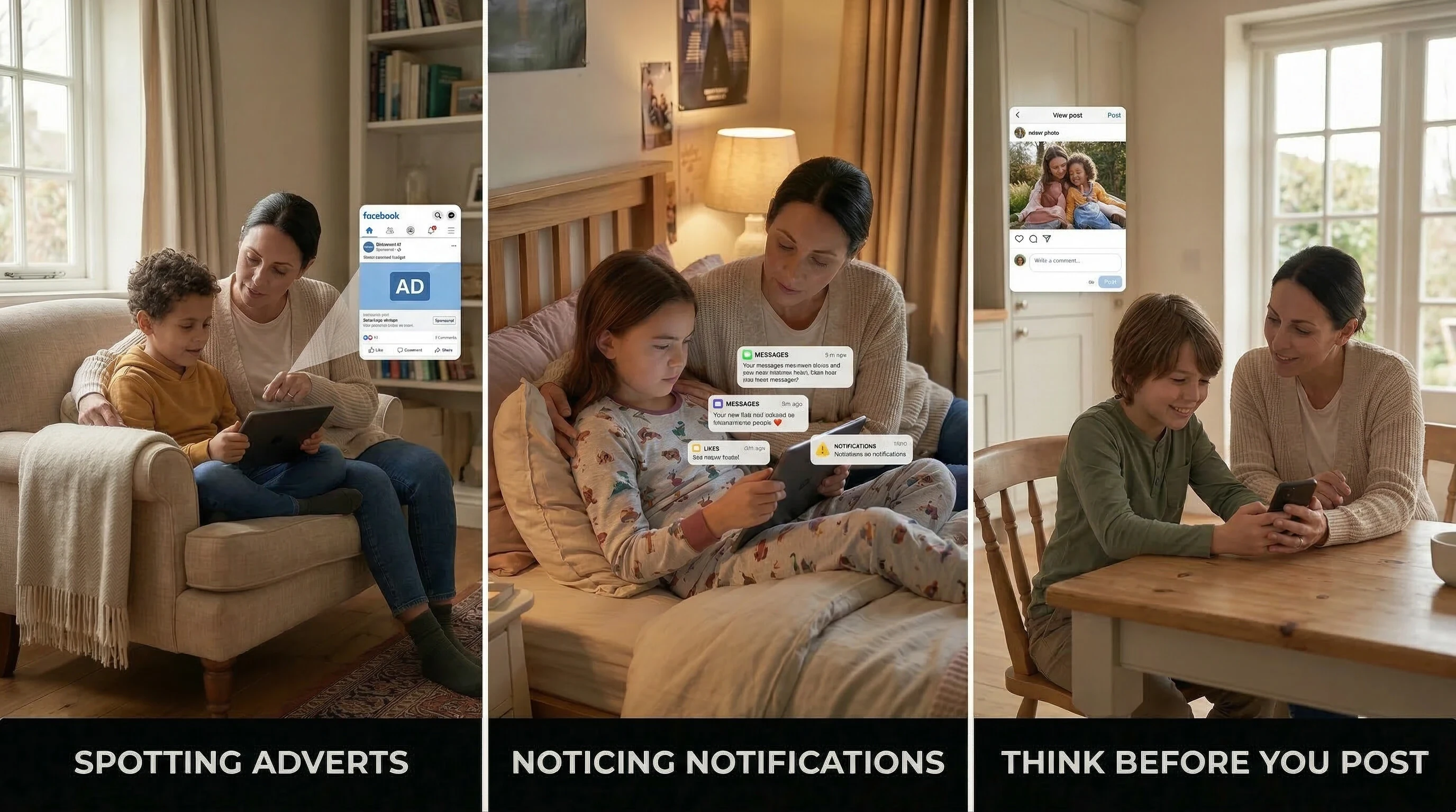
- Discuss notifications: “Why do you think apps send you notifications? Who benefits from you checking your phone?”
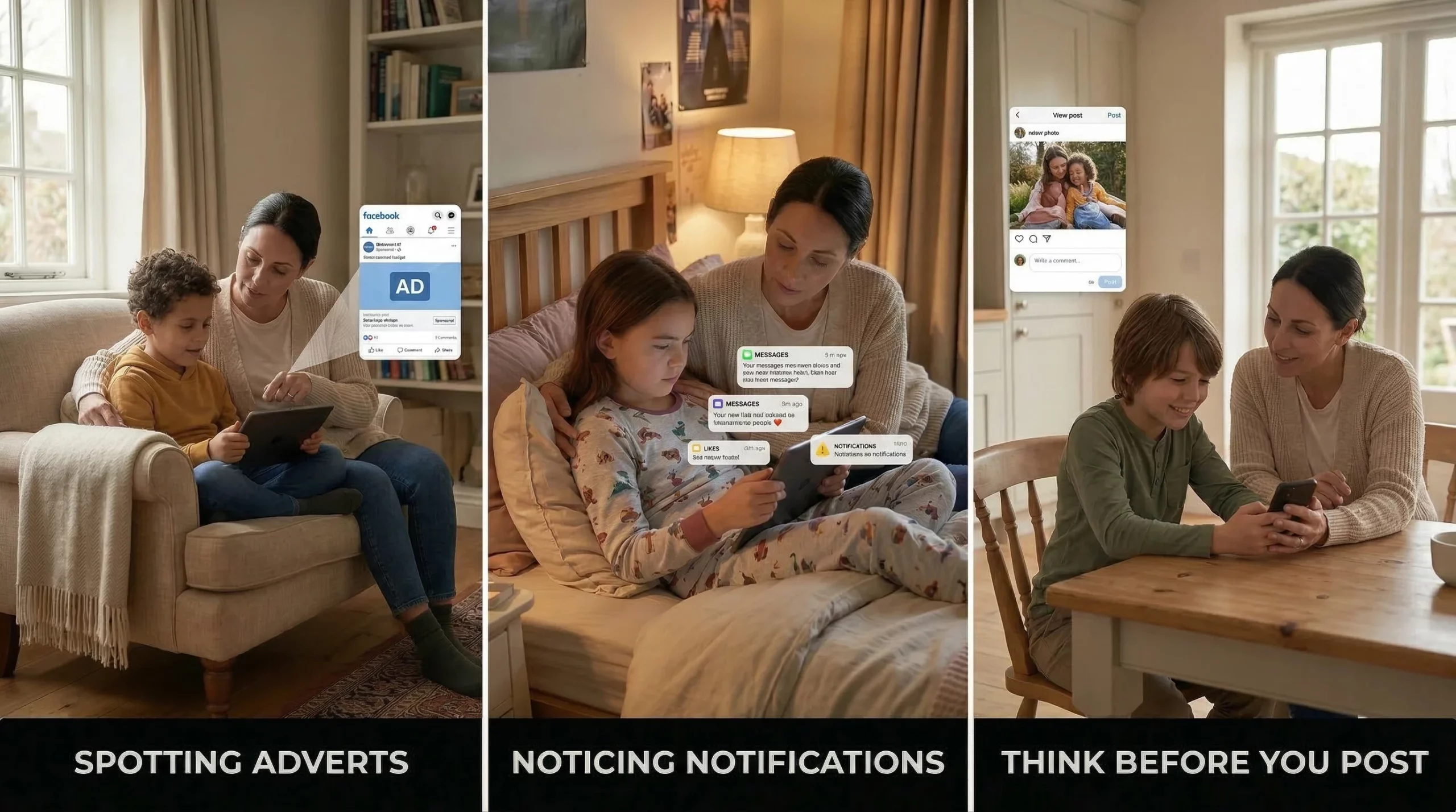
- Talk about advertising: “Can you spot which posts are adverts? How do they make you feel?”
- Explore the idea of attention as a currency: “These apps are free to use — so how do the companies make their money?”
Children who understand how platforms are designed to capture their attention are far better equipped to use them on their own terms.
Raising Children Who Can Come to You
Perhaps the single most important thing a parent can do to raise a safe, thoughtful digital citizen is to keep the lines of communication open. Rules and filters have their place — but they can only do so much. A child who knows they can come to you without judgement when something online makes them uncomfortable, confused, or frightened is far safer than one who navigates it alone for fear of losing their device.
This means:
- Responding calmly when your child tells you something worrying — even if your instinct is to panic or take their phone away immediately
- Thanking them for telling you, and making clear that coming to you was the right thing to do
- Avoiding responses that make them feel punished for being honest
- Revisiting difficult conversations more than once — children often need time to process before they’re ready to talk
Trust, built over years of small conversations, is the most powerful safety net there is.
It’s a Journey, Not a Destination
Raising a digital citizen isn’t a task you complete — it’s an ongoing conversation that evolves as your child grows, as technology changes, and as new challenges emerge that none of us can fully predict yet.
You don’t need to have all the answers. You don’t need to be a tech expert. You just need to stay curious, stay connected, and keep talking — about what your child is doing online, what they’re enjoying, what’s worrying them, and what kind of person they want to be, both on and off screen.
The families who manage the digital world most successfully aren’t the ones with the strictest rules or the most sophisticated parental controls. They’re the ones where conversations happen, mistakes are talked through rather than punished, and children feel genuinely supported to find their own way.
That’s the kind of family you’re already trying to build — and the fact that you’ve read this far is proof enough of that.